


When a warning light appears on your BMW, most drivers immediately want a quick answer. What is wrong, how serious is it, and how much will it cost to fix. A BMW diagnostic test is the starting point for answering all three. It is not just a quick scan. It is a structured process that evaluates how multiple vehicle systems are communicating, where faults originate, and what actions are required to resolve them.
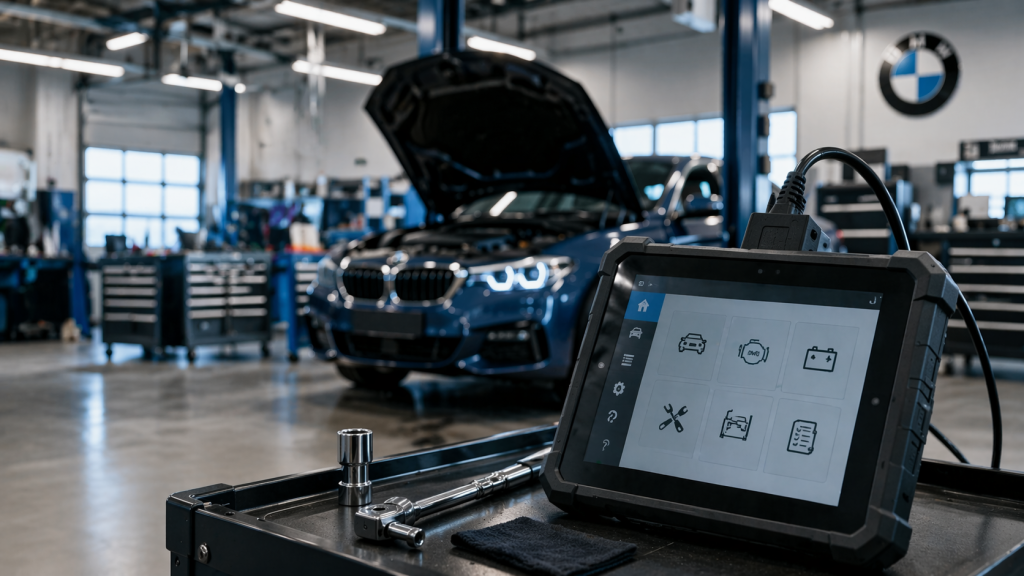
Understanding what you are paying for during a diagnostic test requires looking at how BMW systems work, how faults are identified, and why dealership-level diagnostics provide a different level of insight than basic scan tools.
What does a BMW diagnostic test actually check
A BMW diagnostic test evaluates how the vehicle’s control systems communicate, identify faults, and determine the root cause of a problem. Modern BMW vehicles rely on dozens of electronic control units, each responsible for a specific system such as the engine, transmission, braking, or driver assistance features.
These modules are constantly exchanging data across the vehicle network. When something operates outside of expected parameters, the system logs a fault code. However, that code is not the problem itself. It is a signal that something within the system is behaving incorrectly.
A BMW diagnostic process goes beyond retrieving that signal. It involves analyzing how different systems interact to identify why the fault occurred.
For example, a check engine light on a BMW could be triggered by multiple underlying issues:
- A failing sensor providing inaccurate data
- An air or fuel imbalance affecting combustion
- A communication fault between control modules
- A mechanical issue that is influencing electronic readings
Using BMW-specific diagnostic software such as ISTA, technicians can:
- Access all vehicle control modules, not just engine codes
- Run guided test plans based on BMW engineering logic
- Monitor live system data to observe real-time behavior
- Perform system calibrations and resets when needed
This level of analysis transforms diagnostics from a simple scan into a structured evaluation of how the vehicle is functioning as a complete system. For a BMW owner, this means the diagnostic test is not just identifying a warning. It is isolating the exact cause so repairs are accurate and targeted.
Why does a BMW diagnostic test cost more than a basic scan
A BMW diagnostic test costs more than a basic scan because it involves specialized tools, trained expertise, and a deeper level of system analysis. A generic OBD scanner can read basic fault codes, but it cannot interpret manufacturer-specific data or evaluate how multiple systems interact.
The difference comes down to capability.
Basic scan tools:
- Read limited engine-related codes
- Provide generic fault descriptions
- Do not access all BMW control modules
- Cannot run manufacturer-guided diagnostics
BMW dealership diagnostics:
- Use factory-level ISTA software
- Access every control module in the vehicle
- Run guided troubleshooting workflows
- Interpret data based on BMW engineering standards
The cost of diagnostics reflects more than the time it takes to connect a tool. It includes:
- Investment in BMW-specific diagnostic systems
- Technician training to interpret complex system data
- Time spent isolating root causes rather than symptoms
This distinction matters because a basic scan may point to a component, while a full diagnostic identifies why that component failed. For a BMW owner, this reduces the risk of replacing parts unnecessarily and ensures repairs address the actual issue.
What is included in a BMW dealership diagnostic service
A BMW dealership diagnostic service includes a structured evaluation process designed to identify faults accurately and connect them to a repair strategy. When a vehicle arrives with a warning light or performance issue, the diagnostic process follows a defined workflow.
The process typically includes:
- Initial system scan across all BMW control modules
- Review of stored and active fault codes
- Guided diagnostic testing using BMW ISTA software
- Live data monitoring to observe system performance
- Physical inspection of related components when needed
Each step builds on the previous one. A fault code alone does not determine the repair. It provides a starting point for deeper investigation.
For example, if a BMW reports a misfire condition, the diagnostic process may involve:
- Reviewing ignition system performance data
- Checking fuel delivery consistency
- Evaluating air intake readings
- Inspecting mechanical compression if required
This layered approach ensures the technician is not making assumptions. Instead, they are validating each potential cause using real vehicle data.
From a customer perspective, this means the diagnostic fee covers:
- Access to manufacturer-level tools
- Technician time spent testing and verifying
- A clear direction for necessary repairs
It is not simply a charge to “look at the car.” It is the process that ensures any repair recommendation is based on confirmed data.
How BMW diagnostics influence repairs and costs
A BMW diagnostic test directly influences both the accuracy of repairs and the total cost of ownership. Without proper diagnostics, repairs often rely on guesswork, which can lead to unnecessary part replacements and repeat visits.
A diagnostic test reduces that risk by identifying the root cause before any repair begins.
For example, a warning related to an oxygen sensor could result from:
- A failing sensor
- An exhaust leak affecting readings
- An engine performance issue causing incorrect data
Replacing the sensor without confirming the cause may not resolve the issue. A proper diagnostic process ensures the repair targets the actual source of the problem.
This has two key implications for BMW owners:
- Repairs are more accurate, reducing repeat issues
- Long-term costs are controlled by avoiding unnecessary part replacements
Diagnostics also play a role in maintaining system performance. BMW vehicles are engineered with interconnected systems, meaning one fault can affect multiple areas of the vehicle. Identifying and resolving issues early prevents additional components from being impacted.
In practical terms, the diagnostic test is what turns a warning light into a clear action plan. It defines what needs to be repaired, why it failed, and how to restore the vehicle to proper operating condition.
Connect with us


