


A BMW key fob is more than a remote. It is part of a continuous communication system between you and your vehicle, managing access, authentication, and convenience features like Comfort Access. When the battery begins to weaken, that communication becomes inconsistent, which is why small symptoms like reduced range or delayed response often appear before complete failure.
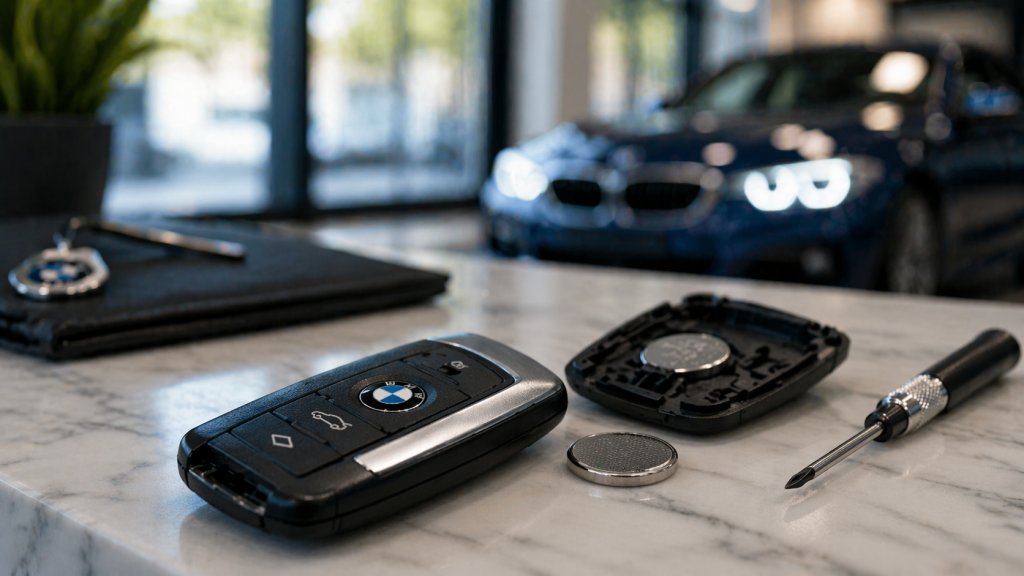
Understanding when to replace your BMW key fob battery and when a full replacement is necessary comes down to how the system works, how signals are transmitted, and how BMW designs its key technology to interact with the vehicle.
How does a BMW key fob actually work
A BMW key fob uses low frequency and radio frequency signals to communicate with the vehicle’s onboard systems. Low frequency signals allow the car to detect the presence of the key nearby, while radio frequency signals transmit commands such as locking, unlocking, or starting the engine.
In BMW vehicles equipped with Comfort Access, this communication is continuous. The vehicle is constantly checking for a valid key signal to allow entry and ignition. That means the key fob battery is not just used when you press a button. It is actively supporting authentication in the background.
Battery voltage plays a direct role in this process. As the battery weakens:
- Signal strength decreases, reducing communication range
- Response time becomes inconsistent
- The vehicle may struggle to detect the key reliably
BMW key systems are also encrypted, meaning the signal must be both strong and accurate to be recognized. If voltage drops below a functional threshold, the system may reject the key entirely even if it is physically present.
For a BMW owner, this explains why a key can appear to “randomly stop working.” The issue is not randomness. It is a gradual decline in signal reliability caused by battery degradation.
When should you replace your BMW key fob battery
A BMW key fob battery should be replaced when signal performance begins to decline or when the vehicle displays a low battery warning. These signs indicate that the battery can no longer maintain consistent communication with the vehicle.
Common indicators include:
- Reduced locking or unlocking range
- Delayed response when pressing buttons
- Intermittent “key not detected” messages
- Warning notifications within the vehicle display
These symptoms occur because the battery can no longer sustain the voltage required for stable signal transmission. In Comfort Access systems, this is especially noticeable because the vehicle relies on continuous communication rather than single button inputs.
Battery lifespan typically ranges between two to four years, depending on usage patterns and environmental conditions. Frequent use of remote functions or leaving the key near the vehicle can accelerate battery drain.
Replacing the battery at the first signs of decline prevents full signal failure. It also ensures that the key continues to function reliably in both active and passive access scenarios.
How BMW key fob battery replacement works
BMW key fob battery replacement involves accessing the internal battery compartment, replacing the cell, and restoring proper signal output. Most modern BMW key fobs use coin-style batteries such as CR2032 or CR2450, depending on the model and key design.
The process varies slightly based on the key type:
- Standard BMW key fobs typically allow manual opening with a release tab
- Comfort Access keys may have sealed or more compact designs
- Some older or rechargeable keys require different handling
In most cases, replacing the battery does not require reprogramming. The key retains its encryption and pairing with the vehicle because the battery powers the signal, not the stored data.
However, proper installation matters. Incorrect battery orientation or poor contact can result in continued signal issues even after replacement.
From a system perspective, replacing the battery restores:
- Full signal strength
- Consistent communication with vehicle modules
- Reliable detection for locking, unlocking, and ignition
For BMW owners, this means battery replacement is not just routine maintenance. It is essential to maintaining uninterrupted access and system functionality.
OEM BMW key replacement vs battery replacement decisions
A BMW key fob should be fully replaced when the issue extends beyond battery-related signal loss and involves hardware failure, damage, or communication faults within the key itself. Understanding the difference prevents unnecessary replacement costs while ensuring reliable operation.
Battery replacement is appropriate when:
- The key functions inconsistently but still responds
- Symptoms improve temporarily after battery change
- Physical condition of the key is intact
Full key replacement is necessary when:
- The key is not detected even with a new battery
- Internal components are damaged or worn
- The key cannot maintain a stable encrypted connection
BMW OEM keys are designed to integrate directly with the vehicle’s security and communication systems. This includes encrypted authentication, Comfort Access compatibility, and synchronization with vehicle modules.
Aftermarket keys often lack:
- Full compatibility with BMW encryption systems
- Reliable signal consistency
- Proper integration with Comfort Access features
This difference matters because the key is not just a remote. It is a security device tied to the vehicle’s identity. Using an OEM BMW key ensures:
- Accurate communication with onboard systems
- Reliable long-term performance
- Proper programming and vehicle recognition
For a BMW owner, the decision comes down to identifying whether the issue is power-related or system-related. A battery resolves signal strength issues. A full replacement resolves hardware or communication failures.
Connect with us


