
Blog / Jacksonville BMW Dealer

BMW X5 xDrive50e Guide for Daily Jacksonville Driving

BMW X5 xDrive50e drivers in Jacksonville can use electric power for shorter trips while keeping gasoline available for longer travel. However, the value of that setup depends on charging frequency and driving distance. The vehicle combines a high voltage battery, an electric motor, and a turbocharged gasoline engine. Therefore, each trip can use electricity, gasoline, or both.

For local travel, the electric portion may cover errands, school runs, or a short commute. Longer routes can bring the gasoline engine into greater use. In addition, drive modes let you decide when you want to use or save battery energy. Home charging also changes how much gasoline you may need during a normal week.

How the BMW X5 xDrive50e Uses Gasoline and Electricity

How does the BMW X5 xDrive50e move between electric and gasoline power? The drivetrain combines battery energy with a turbocharged inline six engine.

The battery sends electricity to an electric motor. Because electric torque arrives quickly, the motor can move the vehicle without waiting for engine speed to rise. However, the gasoline engine remains ready when you need more power or more driving distance.

In HYBRID mode, the vehicle can blend both power sources. Therefore, the engine may start when speed, acceleration demand, or battery level calls for it. ELECTRIC mode gives priority to battery power while enough charge remains.

By contrast, SPORT mode gives the gasoline engine a larger role. That can change throttle response and how quickly the vehicle reacts to stronger accelerator input. The transmission also works with the engine to manage road speed and power delivery.

Regenerative braking adds another layer. When the vehicle slows, the electric motor can recover part of that motion as electrical energy. As a result, some energy returns to the battery instead of leaving only as brake heat.

A test drive should include neighborhood roads, highway merging, and repeated stops. Those situations show how the two power sources share the work.

Electric Range in Jacksonville Heat

Can a Jacksonville commute fit inside the electric portion of the drive? The current X5 xDrive50e carries an estimated electric range near 40 miles.

However, that figure can move with temperature, traffic, wheel choice, and speed. Air conditioning also uses battery energy. Therefore, a hot afternoon trip may draw more electricity than a mild morning route.

Highway travel can also use energy faster than slower city travel. Aerodynamic drag rises as speed increases. For this reason, a longer interstate commute may use the battery faster than a shorter urban route.

A useful comparison starts with your usual round trip mileage. If your daily route stays well below the estimated range, electric travel may cover most of that distance. If your route sits closer to the limit, cooling demand and highway speed deserve more attention.

In addition, you should think about how much charge you want left at home. Some drivers prefer a reserve for an unexpected errand. Others return home and connect the vehicle soon after parking.

Jacksonville heat does not change the basic purpose of the plug in hybrid layout. Instead, it changes how carefully you should compare your route with the available electric distance.

Home Charging and Overnight Replenishment

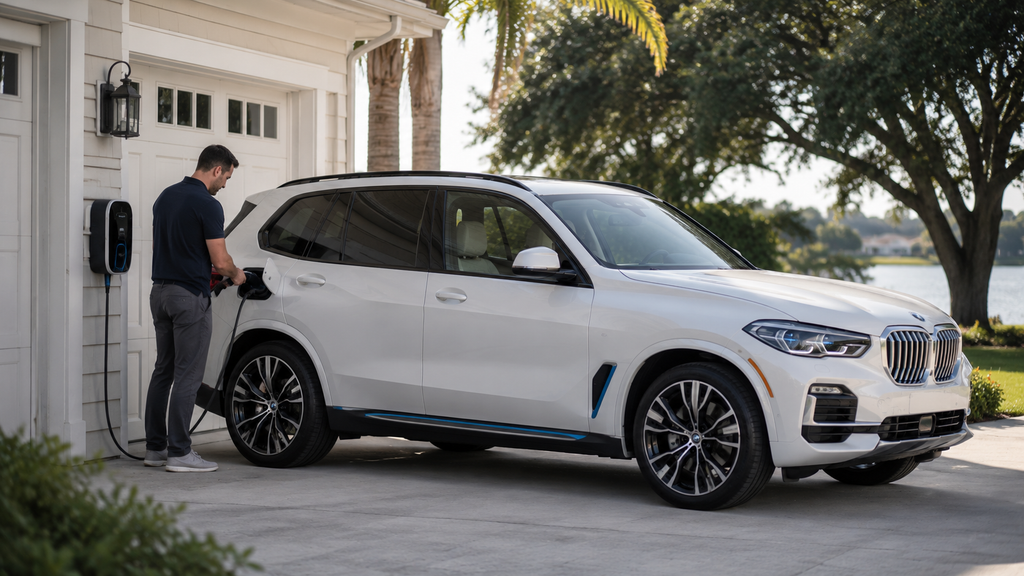
Home charging can decide how much electric travel you get from the BMW X5 xDrive50e. A 120 volt outlet can add energy, while 240 volt charging works faster.

BMW also offers charging equipment for residential use. However, the electrical service at the house matters just as much as the charger. A qualified electrician should review the panel, circuit, parking location, and cable path.

Before relying on overnight charging, review these points:

  • Confirm that the parking space can reach the planned outlet or Wallbox without stretching the cable across a walkway.
  • Ask an electrician whether the panel can support the planned circuit and charging equipment under local electrical code.
  • Compare the expected charging time with the hours the vehicle usually remains parked at home each night.

The X5 xDrive50e carries a smaller battery than a full electric vehicle. Therefore, overnight replenishment may fit easily into many routines. Still, the exact timing depends on the charging source and remaining battery level.

In addition, charging frequency changes gasoline use. A driver who plugs in most nights may complete more local miles on electricity. Someone who rarely charges will ask the gasoline engine to do more of the work.

Driving Modes Control When Electric Energy Gets Used

Why would a driver save battery charge instead of using it first? Battery Hold can preserve charge for a later portion of the trip.

A driver might begin on the highway and finish in slower city traffic. Battery Hold can keep electric energy available until that later segment. However, using the feature well requires some route planning.

HYBRID mode takes a more automatic approach. The vehicle decides when to use the engine, electric motor, or both. Therefore, it can react to speed, accelerator input, battery level, and route demands.

ELECTRIC mode gives battery power priority while charge remains. That can suit shorter Jacksonville errands or a commute that fits comfortably within electric distance. By contrast, SPORT mode keeps the gasoline engine more involved.

HYBRID ECO PRO aims to reduce energy use through more conservative power delivery. However, a shopper should try the available modes instead of judging them only from a menu description.

The goal is to learn which setting matches your routes. Furthermore, the useful mode may change between a weekday commute and a longer weekend drive.

Longer Trips Shift More Work to the Gasoline Engine

What happens after you use the electric portion? The gasoline engine keeps the X5 xDrive50e moving without requiring an immediate charging stop.

That distinction separates a plug in hybrid from a full electric vehicle. You can leave Jacksonville with a full battery and continue after the stored electric energy drops. Therefore, longer travel does not require a charging stop solely to keep the trip moving.

The gasoline engine takes a larger share of the work once battery energy falls. As a result, fuel use rises when more miles occur after the electric portion. Highway speed can increase that gasoline share further.

This makes charging frequency central to the ownership calculation. If you charge before most local trips, the battery can cover a larger share of short distance travel. If you skip charging, the vehicle still drives, but gasoline use rises.

In addition, a long trip can include both approaches. You might begin with battery power, use more gasoline on the highway, then preserve charge for later city streets.

That range of options suits drivers whose schedules change. However, the plug in hybrid setup makes the most sense when charging becomes a regular habit.

Monthly Energy Cost Depends on Electric Miles

How should a Jacksonville driver estimate monthly energy spending? Start by separating electric miles from gasoline miles.

A simple calculation works better than looking at one MPG figure. First, estimate your monthly mileage. Then estimate how much of that distance could occur before the gasoline engine takes over.

Review these inputs before comparing totals:

  • Multiply expected home charging energy by your household electricity rate, then include any public charging you expect to use.
  • Estimate gasoline miles separately, then use local fuel prices and expected fuel economy for the gasoline portion.
  • Include any home electrical work needed for charging, since installation cost changes the first year total.

Because charging habits can differ from one household to another, two drivers can spend very different amounts on gasoline. A short commuter who charges nightly may use little fuel during the week. A longer highway commuter may lean on gasoline more heavily.

In addition, local electricity pricing gives the electric portion its own cost structure. Gasoline prices can move from week to week. Therefore, compare both energy sources using current local rates when you review a lease.

The BMW X5 xDrive50e makes the strongest case when its two energy sources fit your schedule. Your commute length, home charging access, and travel pattern should guide that decision. If electric miles cover much of your local travel, the battery can handle more routine trips. However, the gasoline engine remains ready when your plans extend farther.
Posted in:

Related Posts

BMW Accessories and Genuine Parts for Jacksonville Owners

BMW Accessories and Genuine Parts for Jacksonville Owners

BMW accessories can solve very different needs after you bring your vehicle home. Some protect surfaces, while others support storage, travel, or personalization. Jacksonville driving also brings sand, rain, luggage, groceries, and outdoor gear into the decision. Therefore, the first step is identifying what you want the accessory to do. After that, exact vehicle fit becomes the next priority. Which BMW Accessories Fit the Way You Use Your Car? Which BMW accessories fit the way you use your car? Start with the area you need to protect, organize, carry, or personalize. That approach keeps each purchase tied to a clear task. Floor protection makes sense when shoes carry sand, water, or dirt into the cabin. Cargo products serve a different purpose when groceries or luggage move through the rear compartment. Moreover, roof equipment can free cabin space when larger items need another location. Before ordering, group your needs by what happens most during a normal week. Choose cabin protection when footwells or interior surfaces see frequent moisture, dirt, or family traffic. Choose cargo products when groceries, travel bags, or sports gear need a secure place during the drive. Choose transport equipment when bikes, boards, or larger items need space outside the passenger cabin. Once you know the task, confirm the accessory matches your exact BMW. Model year, body style, trim, and installed equipment can change fit. Additionally, mounting points can differ between vehicles that look very similar from the outside. This step matters because an accessory should work with the vehicle as installed. A close visual match alone does not confirm compatibility. Interior Protection and Cargo Organization Interior products rely heavily on shape and placement. Floor mats are a simple example. A BMW specific mat follows the intended footwell dimensions and retention locations. Therefore, correct fit helps keep the mat positioned where BMW intends. Cargo products require the same attention. A liner must match the floor shape and surrounding trim. Organizers need enough room to sit securely without interfering with other cargo. In addition, seatback products may use specific headrest or mounting designs. Jacksonville routines can make these products easier to prioritize. Beach trips can bring sand and damp items into the cabin. Rainy days may leave more moisture on shoes and floor surfaces. Grocery runs create another concern because loose bags can shift during turns and stops. Weekend travel adds luggage, chargers, smaller bags, and personal items. For this reason, cargo organization can serve a very different role from floor protection. Think about where clutter or wear appears first. Then choose the product category that addresses that area. A driver who rarely carries large cargo may gain more from floor protection. Another owner may need rear storage organization every week. The accessory should follow the repeated task. BMW accessory selection works best when product type follows the owner’s routine. That keeps the purchase focused before model matching begins. Roof and Transport Accessories Roof equipment requires closer fit verification because the hardware attaches directly to the vehicle. The mounting method must correspond with the correct roof configuration. Different BMW models can use different attachment points and roof designs. Can every BMW use the same roof rack? No, the carrier and mounting hardware must match the specific vehicle. Therefore, exact model information matters before placing an order. Start with the item you plan to carry. Bikes, boards, luggage, and other equipment use different carrier designs. Furthermore, the accessory must connect to the approved base hardware for that BMW. Roof transport also requires a few checks before each trip. Confirm the carrier matches the exact BMW model, model year, and roof configuration. Verify the carrier type matches the item you plan to transport. Review the published load limit before adding luggage, bikes, boards, or other equipment. Once mounted, check that the load does not interfere with doors or hatch movement. Visibility should remain clear as well. In addition, straps or attachment hardware should stay secured throughout the trip. For Jacksonville owners carrying beach or outdoor gear, roof storage can free space inside the cabin. However, the mounting setup should come before the packing plan. A vehicle specific carrier gives you a clearer starting point. It also reduces guesswork when choosing compatible hardware. BMW M and Technology Accessories BMW M parts and technology accessories require another level of fit checking. These products may involve exterior panels, wheels, electrical connections, mounting points, or existing factory equipment. BMW matches M parts to particular vehicles. Can any M part fit any BMW? No, the correct component must match the vehicle application. Therefore, exact model information should guide the order. Technology products can add another compatibility step. Some items may rely on available power connections, ports, or factory hardware. In addition, certain accessories may work only with specific equipment already installed in the car. Installation needs also vary widely. Floor mats may require little more than correct placement. Other components can require more involved mounting or electrical work. For this reason, owners should verify installation requirements before ordering. A BMW Center can also confirm whether technician installation is appropriate for a specific product. Genuine BMW accessory warranty terms can vary based on installation timing. Therefore, review the applicable warranty information before finalizing the purchase. The important distinction is not simply the product category. It is how closely that product interacts with the vehicle. A cabin organizer and an exterior BMW M component do not require the same preparation. Treating them differently makes the ordering process more precise. How Do You Order the Right BMW Part? How do you order the right BMW part? Match the item to the exact vehicle before placing the order. BMW uses model information and VIN entry to narrow accessory compatibility. The VIN gives parts staff a precise vehicle identifier. It can clarify model year, configuration, and other vehicle details needed during part matching. Tom Bush BMW Jacksonville also requests vehicle information through its parts form. The form asks for year, make, model, trim, VIN, and the requested item. Before submitting a request, gather those details first. Then describe the item or task as clearly as possible. If you do not know the exact part name, explain what you want to protect, carry, replace, or personalize. That gives the parts team more context for the request. Original BMW Parts also carry BMW warranty coverage. Accessory warranty terms can vary based on when installation takes place. Therefore, review the terms for the exact item before purchase. BMW accessories work best when the selection begins with a clear ownership task. From there, confirm fit against the exact vehicle. Jacksonville owners can use that process for floor protection, cargo equipment, roof products, BMW M parts, and other items. Tom Bush BMW Jacksonville can also assist with parts requests. Bring the vehicle information and describe what you want the item to accomplish. That gives the parts team a clear starting point for matching the correct component.

BMW i5 Versus BMW 5 Series for Jacksonville Driving

BMW i5 Versus BMW 5 Series for Jacksonville Driving

Choosing between t he BMW i5 and BMW 5 Series changes more than the energy source under the floor. Both sedans share the same core 5 Series format, yet they handle energy in very different ways. For Jacksonville drivers, that difference can reshape commuting, highway travel, and weekly planning. The BMW i5 stores electricity in a high voltage battery beneath the cabin. By contrast, the gasoline 5 Series stores fuel in a tank and sends power through an automatic transmission. Therefore, the decision begins with how you drive, where you recharge or refuel, and how far you travel. What Changes When You Choose an i5 Instead of a 5 Series? What changes when you choose the BMW i5 instead of a gasoline 5 Series? The central change is how the car stores energy, sends power to the wheels, and restores that energy. BMW places the i5 battery low beneath the passenger compartment. As a result, the cabin keeps the familiar space expected from the current 5 Series family. The gasoline 530i takes a different mechanical path. Its turbocharged four cylinder engine sends power through an eight speed automatic transmission. Therefore, acceleration involves engine speed, gear selection, and combustion. The i5 uses electric drive motors, so power reaches the wheels through a much simpler drive path. That distinction changes the feel of common driving moments. Leaving a traffic light requires no gear buildup from the electric motor. However, the 530i delivers power through familiar engine and transmission responses. Additionally, a test drive should include city starts, highway merging, and steady cruising. Those situations reveal more than a single horsepower figure. Daily Jacksonville Commuting Changes the Charging Question Do you need public charging for a normal Jacksonville commute? Home charging can cover routine replenishment when suitable charging access is available. BMW supports Level 2 AC charging on the i5, which suits overnight charging at home. Therefore, a driver can plug in after returning home and begin the next day with restored battery energy. Public DC charging serves a different role. BMW supports DC fast charging at rates up to 205 kW on current i5 models. Under suitable charging circumstances, BMW cites about 30 minutes from 10 to 80 percent. However, charging speed changes as the battery fills. The car also manages battery temperature and charging power throughout the session. The gasoline 5 Series keeps a familiar weekly rhythm. You drive until fuel runs low, stop at a station, refill, and continue. By contrast, an i5 owner with home charging may handle most energy replenishment while parked overnight. Therefore, the key question is not how many public chargers exist near home. It is whether your normal parking location supports regular charging. Longer Florida Trips Require Different Planning Can the BMW i5 handle longer Florida trips? Yes, but electric travel asks you to plan energy stops differently from gasoline travel. BMW lists current i5 range estimates that vary by configuration. Therefore, shoppers should review the exact i5 version, wheel setup, and published range before planning a route. A long trip also depends on where fast chargers sit along the route. Starting with a high charge reduces the first charging need. Furthermore, route planning can place charging near meals, rest stops, or other planned breaks. This approach changes the travel schedule without turning every stop into a separate task. Gasoline travel requires less advance energy planning. Moreover, fuel stations remain common along major Florida highways, and a fuel stop usually takes only a few minutes. However, frequent long distance travel does not automatically rule out the i5. A driver who knows regular routes can check charging locations before leaving. For this reason, compare your actual trip frequency before choosing either power source. A monthly highway trip creates a different routine from several long journeys each week. Electric Response and Gasoline Power Feel Different Why does the i5 respond differently from the 530i? Electric motors deliver torque without waiting for combustion, engine speed, or a transmission downshift. That direct response can make the i5 feel immediate when leaving a stop. In addition, the low battery placement gives the electric sedan substantial mass close to the road. The gasoline 530i uses a turbocharged four cylinder engine with an eight speed automatic transmission. BMW lists 255 horsepower for the current 530i. By contrast, current i5 variants use electric motors with output that varies by configuration. Therefore, horsepower alone does not explain the driving difference. Regenerative braking adds another distinction. The i5 can recover electrical energy while slowing and return some of that energy to the battery. BMW also provides selectable recuperation settings through iDrive. As a result, lifting off the accelerator can produce a different slowing response based on the selected setting. A proper comparison should include low speed traffic, highway merging, braking, and steady cruising. Those moments show how each drivetrain communicates with the driver. Which BMW Fits Your Driving Routine? Which BMW fits your driving routine? The stronger match comes from charging access, travel frequency, annual mileage, and your preferred power delivery. Start with your parking location. If you can charge at home, the i5 can move much of your weekly energy routine to overnight parking. Without dependable home charging, public charging deserves closer review. Next, compare how far you travel during a normal week. A Jacksonville commute with local errands places different demands on energy planning than frequent interstate travel. Additionally, calculate what you pay for home electricity, public charging, and gasoline. Those numbers give you a personal cost comparison instead of a universal claim. Service categories differ as well. The i5 does not use engine oil, spark plugs, or gasoline engine filters. However, both cars still need tires, brakes, cabin filters, and other scheduled care. Tire wear also deserves attention because vehicle weight, driving style, and tire choice can change replacement timing. Finally, drive both cars on roads that resemble your normal routes. Compare acceleration, braking, cabin quietness, charging access, and trip planning. The BMW i5 and gasoline 5 Series share a familiar sedan foundation, but their energy routines are distinct. Your schedule will show which one fits more naturally.

BMW Certified Pre Owned

BMW Certified Pre Owned Protection Guide for Jacksonville

BMW Certified Pre Owned vehicles give Jacksonville shoppers a BMW backed process before they compare protection and history. The program begins before warranty terms even become relevant. BMW first reviews age, mileage, records, mechanical condition, and prior care. Therefore, certification involves several checkpoints before a used BMW earns the Certified label. That process matters when you compare Certified inventory with ordinary used inventory. A standard used BMW may still be an excellent choice. However, it does not pass through BMW's Certified requirements unless it qualifies and completes the required review. What Makes a BMW Eligible for Certification What separates a BMW Certified model from another used BMW? Certification starts with eligibility rules before inspection work begins. BMW currently limits qualifying models to five years old or newer. The vehicle must also have fewer than 60,000 miles. In addition, BMW reviews history and maintenance records before certification continues. A vehicle with unacceptable history can fail before the mechanical review reaches completion. Therefore, certification is not a cosmetic label added after detailing. BMW uses age, mileage, records, condition, and inspection results together. Maintenance records also matter because they show how the BMW was cared for before resale. Missing care can raise questions about service history. Likewise, prior damage or improper modifications can interfere with certification. A Jacksonville shopper should review the individual vehicle history before focusing on warranty language. Certification adds BMW requirements, but each used BMW still has its own past. That history should remain part of the decision. What the BMW Certified Inspection Checks What does BMW inspect before approving a Certified vehicle? The review covers mechanical, cosmetic, diagnostic, and road test items. BMW technicians examine tires, wheels, brakes, exterior panels, service status, and mechanical areas. They also review onboard diagnostic information. Furthermore, a road test gives the technician another chance to identify concerns that may not appear while parked. Several inspection areas deserve close attention: Tire tread and wheel condition reveal whether road contact parts meet BMW certification standards before delivery. Brake measurements show whether friction components meet the certification threshold when the technician completes the review. Diagnostic scans can reveal stored faults or electronic concerns that a visual inspection may not show. The road test adds another layer because some concerns appear only while the BMW is moving. Steering response, braking, drivetrain operation, and cabin noises can all receive attention during that drive. However, passing inspection does not make the BMW new again. The vehicle still has prior mileage and prior use. Certification means it met BMW's requirements at the time of review. How BMW CPO Warranty Timing Works When does BMW Certified Pre Owned warranty protection begin? The answer starts with the original BMW New Vehicle Limited Warranty. BMW's new vehicle warranty lasts four years or 50,000 miles, whichever comes first. A younger Certified BMW may still have part of that original term remaining. Therefore, the CPO period may not start on the day you purchase the vehicle. BMW states that CPO protection follows the remaining new vehicle warranty. The CPO Limited Warranty then adds one year with unlimited miles. This sequence makes the original in service date essential. Consider a Certified BMW that still has several months of new vehicle warranty remaining. Those months run first. After that warranty expires, the one year CPO term begins. A shopper should ask for the original in service date and current warranty status. Those two details clarify where the BMW sits on the coverage timeline. BMW CPO Protection Versus a New Vehicle Warranty Does a Certified BMW carry the same warranty as a new BMW? No, the two protection periods follow different terms and timing. A new BMW begins with the four year or 50,000 mile New Vehicle Limited Warranty. A Certified BMW may inherit whatever portion of that original term remains. Afterward, the one year unlimited mileage CPO period can begin. Therefore, comparing only the words "warranty included" can hide the timeline. Two Certified BMWs may have different remaining protection because their original in service dates differ. Review these items before comparing a new BMW with a Certified BMW: Confirm the original in service date so you know how much new vehicle warranty remains. Confirm the current mileage because mileage can end the original warranty before four years pass. Ask for the CPO warranty documents so you can review covered defects and listed exclusions. A newer Certified BMW may still sit mainly within its original warranty. An older Certified BMW may be closer to the CPO portion. The calendar and mileage tell the story more clearly than the Certified label alone. What BMW CPO Coverage Does Not Include Does BMW CPO protection cover every repair? No, BMW uses an exclusionary warranty with items that remain outside the plan. CPO protection focuses on certain defects in materials and workmanship. Routine maintenance does not become free simply because the BMW has certification. Wear related parts can also fall outside warranty protection. That distinction deserves attention before purchase. Brake wear, tires, scheduled service, cosmetic items, and other excluded repairs can remain the owner's responsibility. Therefore, shoppers should read the current warranty document for the specific model year. The inspection and the warranty also serve different purposes. The inspection checks whether the BMW meets certification requirements at that time. The warranty addresses qualifying defects during the covered period. Those two layers work together, but they are not interchangeable. A passed inspection does not promise that every future repair will receive warranty payment. Electric BMW Models Add Separate Battery Protection Certified electric BMW models add another protection layer because the high voltage battery follows separate terms. That battery protection does not use the same one year CPO timeline. BMW states that high voltage battery defect protection can continue for eight years or 100,000 miles. The term begins from the original in service date. Therefore, a Certified electric BMW may retain battery protection beyond the standard CPO period. BMW also lists State of Health protection for qualifying Certified electric models. Current BMW information sets a 75 percent threshold for specified model years and delivery dates. The same eight year or 100,000 mile window applies to that protection. A shopper considering a Certified i4, i5, i7, or iX should separate these timelines. First, review remaining new vehicle protection. Next, review the CPO term. Then review the high voltage battery terms for that exact model. BMW Certified Pre Owned protection gives Jacksonville shoppers several layers to review before choosing a vehicle. Certification starts with eligibility and inspection, then warranty timing adds another decision point. Electric BMW models can add separate battery terms as well. Reading each timeline together gives a clearer view of what the Certified label includes.