

Blog / Jacksonville BMW Service

What BMW Owners Should Know About Brake Service Intervals

BMW vehicles are engineered with advanced braking systems designed to deliver consistent stopping power and predictable pedal feel across a wide range of driving conditions. For many owners, one of the most common maintenance questions is when brake service will actually be required. Unlike older maintenance schedules that relied on fixed mileage intervals, BMW vehicles use a monitoring system that evaluates braking components and predicts service timing based on real driving conditions.

This approach allows BMW brake service intervals to adapt to how the vehicle is used rather than following a universal replacement schedule. Understanding how BMW determines brake service timing, how brake wear sensors work, and why different brake components are monitored separately can help owners interpret service reminders and plan maintenance more effectively.

How BMW Determines Brake Service Timing

Many BMW owners ask whether brake pads follow a fixed replacement schedule. BMW vehicles instead rely on a maintenance monitoring system called BMW Condition Based Service. BMW Condition Based Service is a vehicle maintenance system that uses sensors, elapsed time, mileage, and driving conditions to forecast when service items such as brake pads or brake fluid will need attention.

The system continuously analyzes vehicle operation to estimate remaining service life for several components. Rather than assigning one universal interval for brake service, the system evaluates how frequently and how aggressively the brakes are used.

Several factors can influence BMW brake service timing:

• city driving with frequent braking
• highway driving with longer steady speeds
• vehicle weight and passenger load
• driving style and braking intensity
• road conditions and traffic patterns

Because braking demands vary significantly between drivers, BMW Condition Based Service allows the vehicle to estimate service timing more accurately than a fixed schedule.

What BMW Brake Wear Sensors Are Monitoring

Another question BMW drivers often ask is how the vehicle knows when brake service is required. BMW vehicles use brake wear sensors to help monitor the condition of the brake pads.

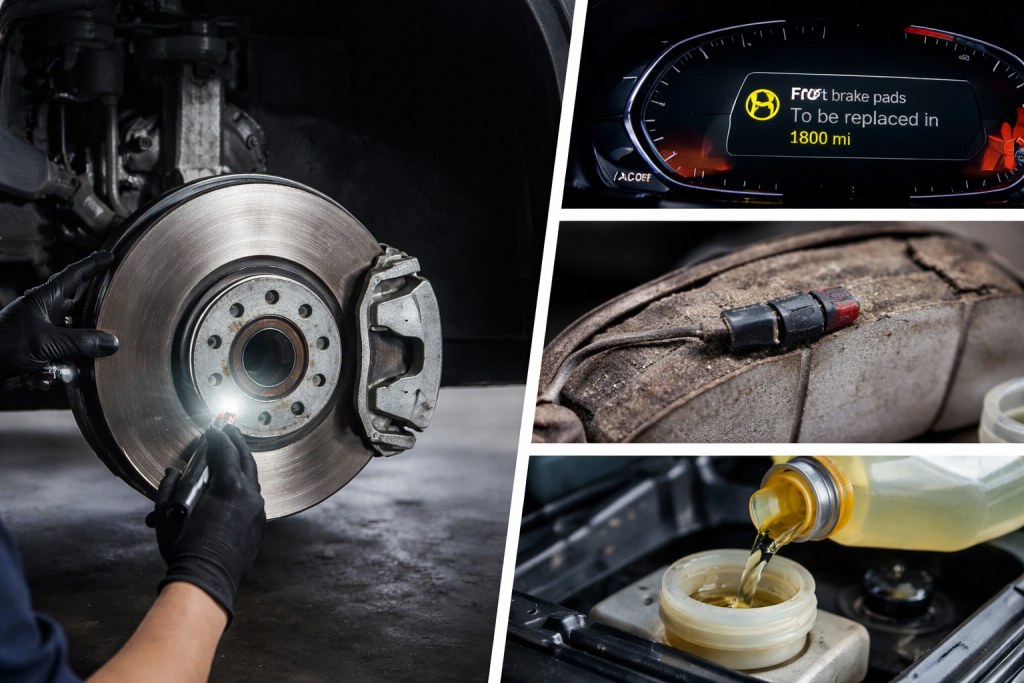
BMW brake wear sensors are electronic components installed in the brake pad assembly that detect when pad material has worn close to its service limit. When the pad thickness approaches a predetermined threshold, the sensor triggers a service message within the vehicle’s maintenance display.

This warning gives drivers advance notice that brake service will soon be required. The system helps prevent situations where brake pads wear down too far and begin damaging the brake rotor.

The brake monitoring system works together with the BMW Condition Based Service system to estimate the remaining lifespan of the brake components. Drivers typically see this information in the vehicle’s maintenance status screen, which displays the estimated distance remaining before brake service is needed.

Why Front and Rear Brake Service Intervals Can Differ

Many owners are surprised when their BMW indicates that front and rear brake pads require service at different times. This difference occurs because braking forces are not distributed evenly between the front and rear wheels.

During most braking events, a vehicle’s weight shifts forward. This weight transfer places a greater load on the front brakes, which means the front brake pads often experience more wear than the rear pads.

BMW vehicles monitor front brake pads and rear brake pads as separate service items. This allows the maintenance system to recommend service for each axle based on its actual wear rather than assuming all four brakes wear evenly.

For drivers, this means it is normal for brake service timing to vary between the front and rear braking systems. In many cases, front brake pads may require replacement earlier than the rear pads because they handle a greater share of braking force.

Why Brake Fluid Service Is Tracked Separately

Brake service reminders sometimes include brake fluid replacement even when brake pads still have remaining life. This can be confusing for owners who associate brake service only with pad wear.

Brake fluid plays a different role within the braking system. Hydraulic brake fluid transfers force from the brake pedal to the brake calipers, allowing the vehicle to apply braking pressure to the wheels.

Over time, brake fluid gradually absorbs moisture from the surrounding air. This moisture contamination can reduce the fluid’s boiling point and affect braking performance during heavy braking conditions.

Because fluid degradation occurs gradually with time rather than mileage alone, BMW tracks brake fluid replacement using a time based service interval instead of a wear measurement. Even vehicles that are driven relatively few miles may still require brake fluid service after a certain period of time.

Separating brake pad wear from brake fluid service allows BMW’s maintenance system to ensure that both mechanical wear and fluid condition are addressed at the appropriate intervals.

Understanding BMW Brake Warning Messages

BMW drivers may encounter several types of alerts related to brake service. These alerts are designed to provide early notification that maintenance will soon be required.

Service messages typically appear within the vehicle’s maintenance display and may include an estimated number of miles remaining before brake pad replacement is recommended. These messages allow drivers to plan service before the braking components reach their wear limits.

In some cases, drivers may not see detailed brake pad status far in advance. Certain BMW vehicles only display the remaining brake pad service estimate once the vehicle approaches the final portion of the service interval. This behavior helps ensure that the maintenance display provides accurate information as the system approaches the service threshold.

Understanding how these alerts function can help owners interpret service messages correctly and schedule maintenance at the appropriate time.

BMW braking systems are engineered to maintain reliable performance while giving drivers clear insight into upcoming service needs. By using brake wear sensors and the BMW Condition Based Service system, the vehicle can estimate brake service intervals based on real driving conditions rather than relying on fixed mileage estimates. For owners, this monitoring approach helps ensure that brake pads, brake fluid, and related components receive attention when they are truly needed, supporting both safety and long term vehicle performance.


Posted in:

Related Posts

BMW tire pressure monitoring and tire maintenance

BMW Tire Pressure and TPMS: What Jacksonville Drivers Should Know

Your BMW's performance, handling, and safety depend heavily on your four tires. Keeping them properly inflated and knowing how your Tire Pressure Monitoring System (TPMS) works are simple ways to protect your tires, save on gas, and enjoy a smoother drive around Jacksonville. Here is what every BMW owner should know about tire maintenance and pressure settings. Find the Correct Pressure for Your BMW There isn’t a one-size-fits-all tire pressure for every BMW. The ideal cold inflation pressure depends entirely on your specific model, wheel and tire setup, cargo load, and driving habits. You’ll find your car’s tire pressure numbers printed on the tire pressure placard inside the driver’s door jamb, as well as in your owner’s manual. Be sure to use these recommended numbers rather than the maximum pressure listed on the side of the tire itself. Why Front and Rear Pressures May Differ It’s completely normal for front and rear tires on a BMW to require different pressures. Many BMWs run staggered wheel setups—where the rear tires are wider than the front—or carry weight differently across each axle. Your owner’s manual may even list different targets depending on how many passengers or how much luggage you’re carrying. If you’ve upgraded your wheels or swapped to a non-factory tire size, come by Tom Bush BMW so a service advisor can help you pinpoint the right PSI for your new setup. How Jacksonville's Weather Impacts Your Tire Pressure Living in Jacksonville means dealing with sudden weather swings, and tire pressure moves right along with the temperature. Generally, tire pressure drops as temperatures cool down overnight, which is why that warning light often pops up on colder mornings. Always check and adjust your tires when they are cold (before driving more than a mile or two). If you check your tires after cruising down I-95 on a hot afternoon, the reading will naturally be higher due to heat buildup never let air out of a warm tire to match the door sticker. What the Tire Pressure Monitoring System Does Your BMW’s Tire Pressure Monitoring System (TPMS) keeps an eye on tire pressure and lets you know the moment something is off. Depending on your iDrive system, you might see exact real-time pressures for each tire or a general warning light on the dash. While TPMS is a fantastic safety net, it isn't a replacement for a reliable handheld pressure gauge. Whenever you top off your tires or have them rotated, be sure to reset the TPMS in your iDrive menu so it can re-learn the correct baseline. When to Bring Your BMW In for Tire Service If your low-pressure light stays on, one tire keeps losing air every few days, or you feel an unusual vibration in the steering wheel, don't ignore it. Driving on a severely underinflated tire can ruin the sidewall and damage your wheels. If you suspect a slow leak, valve stem issue, or rim damage, our team at Tom Bush BMW Jacksonville is here to inspect your tires, fix the root cause, and get you back on the road safely.

BMW Warning Lights and Service Guidance in Jacksonville

BMW Warning Lights and Service Guidance in Jacksonville

BMW warning lights can turn a normal Jacksonville drive into an immediate decision. The first step is identifying the light, its color, and the Check Control message. BMW stores those messages in Vehicle Status, which gives more detail than the icon alone. Therefore, do not rely on color by itself. Read the message, notice how the car feels, and decide whether driving should continue. What Should You Check When a BMW Warning Light Appears? What should you check when a BMW warning light appears? Check the warning color first, then read the BMW Check Control message for more detail. Additionally, the instrument cluster gives the first visual cue. Therefore, the message adds context about the monitored area. BMW owners with newer iDrive versions can review stored Check Control messages in Vehicle Status. Additionally, the My BMW App can show vehicle status details after the car sends an update. That makes it easier to review a message again after parking. Still, color matters because it can show urgency. However, the exact meaning comes from the specific message and the way the car responds. A yellow icon may call for prompt attention. A red warning can point to a more serious concern that deserves immediate caution. Before moving on, note a few details. Record the warning color, symbol, and exact Check Control message before it disappears. Notice whether steering, braking, acceleration, temperature, or electrical functions feel different. Note when the warning appeared and whether it stayed active after restarting the car. Therefore, those details give you a clearer basis for the next step. They also give the service team more useful information later. When Should You Stop Driving? When should you stop driving? Stop when the warning indicates a serious fault or the vehicle shows unsafe symptoms. The message in iDrive should guide the first response. However, the way the car behaves matters just as much. Additionally, a brake warning deserves close attention if braking feels weak, uneven, or unusual. A coolant temperature warning also deserves caution because excessive heat can damage engine components. Additionally, a battery warning may signal trouble within the charging network. Do not continue driving if you see smoke, smell burning material, or notice a major fluid leak. The same applies when steering becomes difficult or the car loses substantial power. In those situations, move to a safe location when possible. Still, a red light does not tell you the failed part by itself. Therefore, avoid guessing about the repair from the icon alone. Read the message and follow the instruction shown by BMW. If the car remains safe to operate and the message permits continued travel, drive gently to an appropriate destination. Then arrange service as soon as possible. Check Engine and Other Yellow Warnings A yellow warning usually signals that the car needs attention, but the exact message still matters. For this reason, the check engine light is a common example. It can appear when monitored engine or emissions data falls outside the expected range. Can you keep driving with a check engine light? That depends on the message and how the car is operating. A steady light with normal driving response differs from a flashing light or severe drivability problem. Therefore, read the Check Control message before making the next decision. However, the light alone does not identify one failed part. BMW uses diagnostic data to narrow the cause. That process may involve stored fault codes, live data, electrical checks, or component testing. Additionally, other yellow warnings can point toward service needs that are less urgent than a red alert. Still, they should not be ignored. A warning that returns again deserves inspection even when the car seems normal. For this reason, use the warning as the start of a diagnostic process. Do not treat it as a complete diagnosis. Tire Pressure and Other Driver Check Items Some warnings let you perform a simple visual check before service. For this reason, tire pressure is one of the clearest examples. BMW Tire Pressure Monitor data can show current pressure information through Vehicle Status. What should you do after a tire pressure warning? Park safely, inspect the tire, and compare the displayed pressure with the target value. Look for obvious damage, a visibly low tire, or an object in the tread. Additionally, the warning may appear after pressure drops in one tire. Temperature changes can also change displayed pressure values. However, a sudden or large drop deserves closer attention. BMW owners can use Vehicle Status to review tire information. Additionally, some models show current tire temperature along with pressure data. That gives more context before you decide whether to continue driving. Use a simple check before moving again. Inspect the tire for visible damage, a puncture, or a sidewall problem. Compare the current pressure with the target pressure shown by the vehicle. Avoid driving farther if the tire looks unsafe or loses pressure quickly. A tire warning should lead to verification, not guesswork. If the pressure drops again after correction, schedule an inspection. Prepare for BMW Service Therefore, a warning light visit goes more smoothly when you arrive with useful details. The service team needs more than the name of the icon. The exact message, timing, and driving symptoms give better diagnostic context. What should you record before scheduling? Note the color, symbol, Check Control text, and any change in how the BMW drove. Additionally, note whether the warning stayed on, disappeared, or returned after a restart. A photo of the warning can also be useful when it appears safely while the car is parked. Do not photograph the display while driving. Instead, capture the message after stopping in a safe place. Tom Bush BMW Jacksonville offers online service scheduling for local BMW owners. When you book, include the warning details and any related symptoms. That gives the technician a clearer starting point for diagnosis. BMW warning lights are most useful when you treat them as action signals, not repair answers. Read the message, judge urgency, and check what you can safely inspect. Then schedule service when the warning calls for professional diagnosis.

BMW Maintenance for Higher Mileage in Jacksonville

BMW Maintenance for Higher Mileage in Jacksonville

BMW maintenance becomes more important as mileage rises and service history grows longer. No single odometer number can predict how long every BMW will remain on the road. A well documented vehicle may age very differently from one with missed service or unresolved repairs. Therefore, Jacksonville owners should look beyond mileage alone. Oil care, cooling health, fluid age, battery testing, and service records all add useful context. A careful review shows what the car has received and what may need attention next. How Many Miles Can a BMW Last? How many miles can a BMW last? No single mileage figure applies to every BMW because service history and mechanical condition vary. Additionally, two cars can show the same odometer reading while having very different histories. Moreover, one may have regular oil service and prompt repairs. Another may have long gaps in maintenance or unresolved warning signs. Therefore, start with records before making assumptions from mileage. Review oil services, cooling repairs, fluid work, battery replacement, brake service, and inspection notes. In addition, note whether major repairs were completed when symptoms first appeared. Prompt repairs can prevent one issue from placing extra strain on nearby components. Furthermore, a higher mileage BMW also deserves a current inspection. Listen for unusual noises during startup and driving. Check for fluid leaks, warning lights, uneven tire wear, and changes in braking. Moreover, a diagnostic scan may uncover stored faults that are not obvious during a walkaround. Still, mileage matters because components accumulate cycles and wear. However, the odometer works best as one part of a larger mechanical record. Oil and Cooling Care Protect Major Engine Components Engine oil creates a lubricating film between moving metal surfaces. It also carries heat and contaminants away from critical areas. As oil ages, contamination and thermal stress can reduce how well it performs those jobs. Therefore, correct oil service remains a central part of BMW maintenance. Why does oil specification matter? BMW engines require oil that meets the correct viscosity and approval requirements. The wrong product may not provide the intended protection across temperature changes and engine loads. For this reason, owners should follow the specification listed for their exact BMW. In addition, cooling care deserves equal attention in Jacksonville. Coolant circulates through the engine and transfers heat toward the radiator. Pumps, hoses, thermostats, seals, and heat exchangers all take part in that process. A weak component can reduce temperature control before a major warning appears. Before an overheating event occurs, watch for coolant loss, visible residue, unusual temperature readings, or repeated low coolant messages. In addition, inspect hoses and connections during routine service. For this reason, these two areas protect different parts of the same engine. Oil reduces friction inside moving assemblies. Coolant carries excess heat away from hot engine areas. Brake Fluid and Battery Care Depend on Time Too Low annual mileage does not remove every maintenance need. Some service items change with age even when the odometer moves slowly. Brake fluid is one example because it can absorb moisture through the hydraulic circuit as it ages. Why does that matter? Added moisture can lower the fluid's boiling point and change braking response under heat. Therefore, brake fluid service should follow the applicable BMW schedule, not mileage alone. Additionally, battery health deserves attention as a BMW ages. The 12 volt battery supports starting and many electronic functions. Heat can accelerate chemical aging inside a battery. Jacksonville owners may therefore find battery testing useful before a weak unit causes starting trouble or electrical faults. A service visit can review several age sensitive areas at once. Ask for brake fluid history when records are incomplete, since elapsed time matters alongside mileage. Request battery testing when starting becomes slower or the battery's installation date is unknown. Review coolant history and visible connections when the car has spent years in sustained Florida heat. These checks do not predict a fixed lifespan. Instead, they show whether time based service has kept pace with the vehicle's age. Service Records Tell a Larger Story Moreover, service records can reveal far more than a mileage number. They show whether routine work happened on schedule and whether repairs were delayed. Therefore, a documented history gives owners and used car shoppers a clearer view of prior care. What should you look for first? Start with recurring maintenance and larger repairs. Oil services, brake fluid work, cooling repairs, battery replacement, brakes, tires, and inspection records provide useful clues. Then look for gaps. A long period without documentation does not prove that service was missed. However, it creates an unanswered question that deserves closer inspection. In addition, repeated repairs in the same area may justify a deeper mechanical review. A useful record review should cover a few core areas. Confirm recurring oil service and note which oil specification was used when records provide that detail. Look for cooling work, including pumps, hoses, coolant service, or leak repairs. Compare battery, brake, and tire dates with current condition and measured wear. Furthermore, records help establish what may come next. If a major service item was completed recently, that changes the near term maintenance outlook. If its history is unknown, inspection becomes more useful. What Should You Check Before Choosing a Higher Mileage BMW? What should you check before choosing a higher mileage BMW? Review service records, fluid care, cooling history, battery condition, brakes, tires, and current diagnostic findings. Those areas create a more complete view than mileage alone. BMW Certified Pre Owned vehicles add a structured inspection layer. BMW reviews maintenance history and performs mechanical, brake, tire, diagnostic, and road test checks. Therefore, certification can provide documented evidence about current condition at the time of inspection. Certification does not promise a specific future mileage. Mechanical parts continue to age after the inspection. Service, driving patterns, repairs, and component wear will continue to shape what happens next. For a noncertified vehicle, an independent pre purchase inspection can serve a similar decision purpose. Ask the technician to review fluid leaks, cooling components, brakes, tires, battery health, stored faults, and recent service history. Jacksonville owners planning to keep a BMW for many years should use the same mindset. Keep records organized, respond to warning signs early, and review age based service along with mileage based items. A clear maintenance history makes future decisions easier and gives the next inspection far more context.