


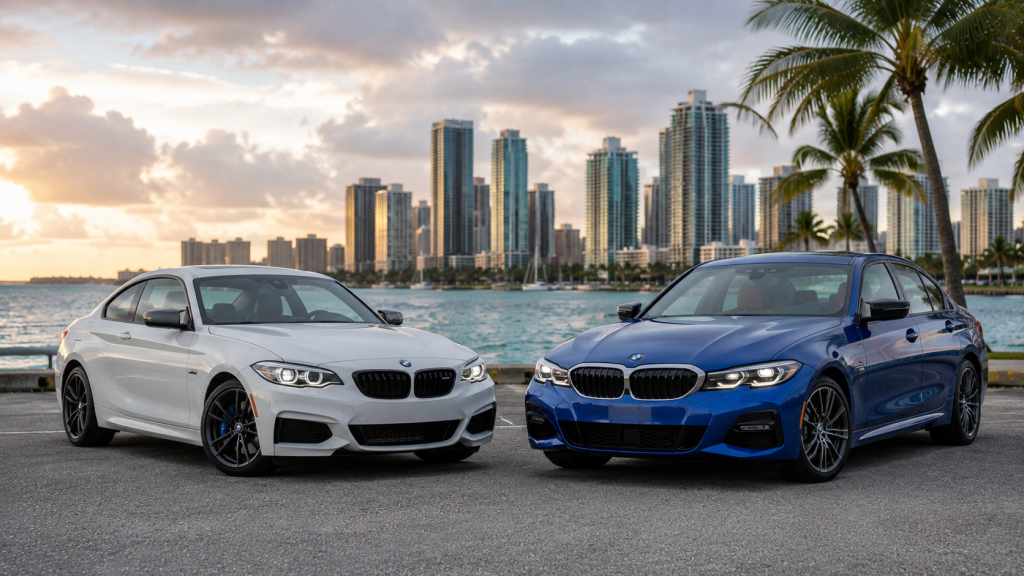
BMW 2 Series vs 3 Series is one of the most common comparisons shoppers run before visiting a BMW dealership, and the two models are closer in some areas and further apart in others than most side-by-side spec lists suggest. Both carry the same TwinPower Turbo engine at their respective base trims, share platform architecture, and are sold under the same badge. However, the body format, chassis calibration, and interior geometry each pull in different directions, and understanding those differences is what separates a good purchase decision from a regrettable one.
Size and Body Format: More Than a Visual Choice
The most foundational difference between the two models is the body itself. The 2 Series Coupe is a two-door vehicle with a sloped roofline, a shorter overall length of 179.0 inches, and a wheelbase of 107.9 inches. The 3 Series is a four-door sedan measuring 185.9 inches in length with a 112.2-inch wheelbase. That 4.3-inch wheelbase gap is not a styling choice. It is a structural decision that shapes how each car moves.
A longer wheelbase spreads the vehicle’s weight over a greater span between the front and rear axles. For the 3 Series, that translates to more absorption of road imperfections and a more settled character on highways. The 2 Series coupe’s shorter wheelbase concentrates mass closer to the center of the car. Cornering forces act on a shorter moment arm, which is why direction changes in the two-door feel more immediate.
The roofline geometry carries its own set of consequences beyond appearance. A coupe’s sloped rear glass reduces the available headroom for rear occupants. The 2 Series Coupe delivers 35.0 inches of rear headroom versus 37.6 inches in the 3 Series. That 2.6-inch reduction is not a number on a sheet. It is the physical clearance above the head of anyone seated behind the driver, and it follows directly from the coupe’s profile shape.
What Separates the 230i and 330i Despite a Shared Engine?
Both the 230i and 330i use BMW’s 2.0-liter TwinPower Turbo inline four-cylinder producing identical output of 255 horsepower and 295 lb-ft of torque. Furthermore, both pair that engine with an 8-speed automatic transmission. Shoppers who stop at that comparison frequently conclude the driving experience should be nearly equivalent. The chassis tells a different story.cargurus+1
The 2 Series Coupe weighs 3,446 pounds at the curb. The 3 Series sedan comes in at 3,644 pounds, a difference of 198 pounds. That weight gap, when driven through the same power output, produces a measurable difference in how each car responds to throttle input. Beyond that, suspension tuning diverges between the two platforms even where hardware overlaps.
Here is what those differences produce in driving:
- The 230i posts a tighter turning circle of 36.4 feet versus the 330i’s 37.4 feet, which reflects both the shorter wheelbase and the coupe’s narrower front geometry.
- The 2 Series delivers 26 city and 35 highway mpg; the 3 Series returns 28 city and 35 highway, with its larger 15.6-gallon tank extending its highway driving range to 546 miles versus 480 for the coupe.
- The 3 Series begins at $49,350 MSRP compared to $43,550 for the 2 Series, a gap that reflects the sedan’s additional structural investment in interior space and rear-seat geometry.
At the performance trim level, the M240i produces 382 horsepower and the M340i produces 386 horsepower, both through the B58 3.0-liter inline-six. The output figures are nearly indistinguishable. However, the M240i delivers that power through a lighter, stiffer coupe chassis. The M340i channels the same engine through the sedan’s longer, heavier platform. The result is two different sensations from the same core hardware.
How Chassis Tuning Creates Two Distinct Driving Characters
The 2 Series and 3 Series share engineering lineage, and yet a driver switching between them notices a meaningful shift in how each responds. That difference comes from suspension calibration, not engine output. BMW tunes the 2 Series Coupe with stiffer spring rates and a firmer damper setup relative to the 3 Series. The shorter wheelbase amplifies that tuning by reducing the lever arm the chassis uses to resist lateral forces during cornering.
Body roll is the most direct way to feel this difference. In the coupe, the stiffer calibration and shorter chassis geometry limit lean through corners. The 3 Series manages body roll within a controlled range, but its tuning allows slightly more movement to absorb the demands of daily commuting and passenger comfort over longer distances. Neither calibration is a compromise. They are two purposeful answers to different priorities.
Steering feel follows the same pattern. The 2 Series delivers a more immediate connection between wheel input and vehicle response, a consequence of the shorter wheelbase reducing the delay between what the driver asks and what the car does. The 3 Series uses a more progressive steering calibration that lightens effort at higher speeds and reduces fatigue on longer drives. Drivers who spend most of their time on two-lane roads will notice the coupe’s directness. Drivers who spend most of their time on interstates will appreciate the sedan’s composure.
Rear Seat Access and Cargo Space: Why Format Changes Everything
Interior volume comparisons between a two-door coupe and a four-door sedan frequently mislead because they treat cubic footage as a proxy for usability. The 3 Series offers 35.2 inches of rear legroom and 37.6 inches of rear headroom. The 2 Series Coupe delivers 32.2 inches of rear legroom and 35.0 inches of rear headroom. Those three-inch gaps in both dimensions reflect structural geometry, not design neglect.
In a four-door format, rear passengers have a dedicated door opening sized for adult entry. In a two-door format, rear entry requires the front seat to fold forward. That process adds steps and reduces access clearance, which becomes a consistent friction point for anyone who regularly loads rear passengers. The 3 Series is rated for five occupants; the coupe seats four. That additional position is not an arbitrary spec. It follows from the sedan’s ability to accommodate a fifth person at the rear center seat without the packaging constraints of a coupe body.
Cargo space reflects the same logic. The 3 Series carries 16.9 cubic feet of trunk volume against the 2 Series Coupe’s 13.8 cubic feet. Beyond that raw figure, the sedan’s trunk opens to a full-width aperture that is not narrowed by a sloped rear glass. The coupe’s trunk is shaped by the roofline and loads more narrowly as a result. For drivers who occasionally need the trunk, neither limits daily use. For drivers who consistently need full cargo access, the sedan’s opening is the more accommodating format.
Choosing Between the Two Models Based on How You Drive
The question of which BMW to buy resolves most clearly when framed around driving pattern rather than specification rank. A driver who commutes alone or with one passenger, covers mostly shorter routes, and values the sensation of a car that responds sharply to input will find the 2 Series Coupe serves those conditions well. The lighter chassis, stiffer calibration, and two-door profile are not limitations in that context. They are the product’s defining character.
A driver who regularly carries rear passengers, covers highway miles on a consistent basis, or wants a car that adapts across a wider range of duties will find the 3 Series addresses those requirements without trade-off. The additional wheelbase, rear-seat access, and suspension calibration all reflect a car built for broader daily demands. The five-year true cost of ownership comes to $56,334 for the 2 Series Coupe and $62,214 for the 3 Series, a gap that reflects the sedan’s additional capability in interior space, passenger geometry, and fuel capacity.
For drivers drawn to the six-cylinder tier, the M240i and M340i sharpen the distinction. The M240i puts the B58’s output through a lighter platform tuned for driver engagement above all else. The M340i routes the same power through a platform built to balance that engagement with composure and rear-seat usability. Both are purposeful products. The right one is determined by which trade-off fits the way the car will actually be used, not by which specification looks stronger on a comparison chart.
Connect with us


