


BMW i4 shoppers in Jacksonville may find the 3 Series familiar at first. However, charging, fueling, and power delivery shape the daily routine. In addition, both models serve drivers who want a compact BMW with four doors and strong road manners. However, their drivetrains ask for different habits.
The i4 stores energy in a high voltage battery and sends it to an electric motor. The 330i uses gasoline, a turbocharged four cylinder engine, and an eight speed automatic transmission. Therefore, choosing between them means looking past size and styling. Your commute, parking setup, travel plans, and energy costs deserve equal attention.
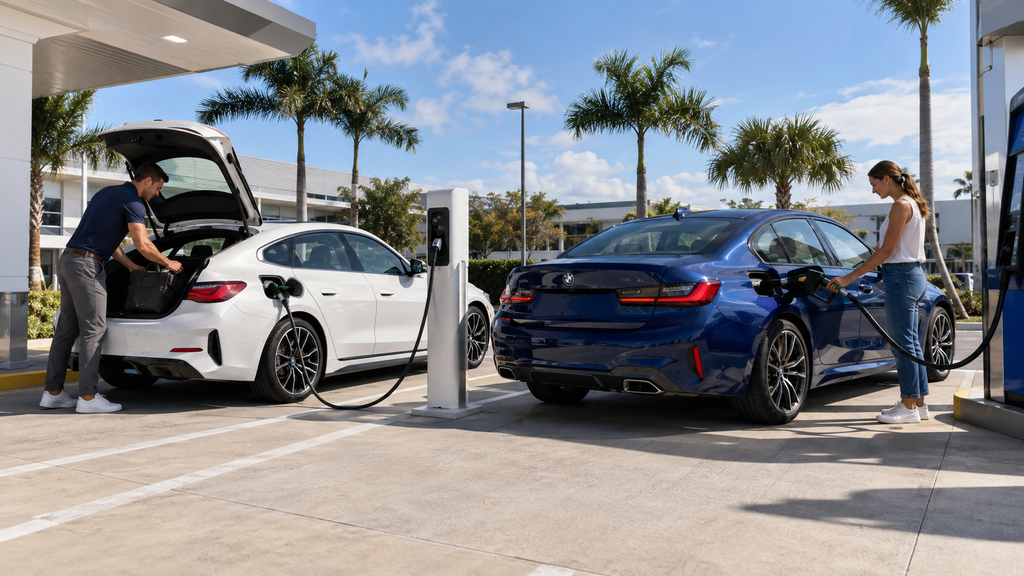
BMW i4 and BMW 3 Series Start With Two Different Powertrains
What changes when you choose a BMW i4 instead of a BMW 3 Series? The largest change is how each car stores energy and delivers power.
Therefore, the i4 uses battery electricity to turn an electric motor. Because an electric motor can deliver torque without waiting for engine speed to rise, response starts quickly. There are no conventional gear changes during acceleration. Therefore, the sensation can feel direct and smooth from a stop.
By contrast, the 330i takes another route. Its turbocharged four cylinder engine burns gasoline and works through an eight speed automatic. As speed rises, the transmission changes ratios to keep the engine within a useful operating range. You feel those shifts as part of the car’s acceleration pattern.
In addition, regenerative braking separates the two cars. When the i4 slows, its electric motor can recover some motion and return energy to the battery. The 330i relies on its braking hardware while the engine and transmission continue their normal roles. Therefore, pedal response and deceleration can feel different during the same Jacksonville commute.
A shopper should evaluate more than acceleration figures. Pay attention to throttle response, braking feel, noise, and the rhythm of stop and go traffic. Those details reveal which drivetrain feels more natural to you.
What Jacksonville Heat Means for BMW i4 Range
How should summer heat factor into BMW i4 range planning? Heat can raise the energy needed for cabin cooling, while speed and wheel choice also shape driving range.
Because both functions need energy, the i4 must power propulsion and climate control from the battery. Therefore, strong air conditioning demand can reduce the energy left for driving. Highway speeds can also raise energy use because aerodynamic drag increases as speed rises. Larger wheels and certain tire choices can change efficiency as well.
Therefore, BMW lists estimated range by i4 configuration, with no single number covering every version. The current i4 eDrive40 carries an estimated range above 300 miles in certain configurations. Other i4 variants carry different estimates. Therefore, shoppers should compare the exact model, wheel package, and drive layout they are considering.
In addition, Jacksonville commuting makes charging reserve worth planning. A normal weekday route may use only part of the battery. Still, an airport run, beach trip, or longer interstate drive can change the day’s mileage quickly. Keeping a comfortable reserve can make those schedule changes easier to handle.
The useful question is not whether Florida heat makes an i4 unsuitable. Instead, ask how your normal mileage compares with the selected i4’s estimated range. Then account for cooling, highway travel, and the charge level you prefer to keep available.
Home Charging Changes the Daily Routine
For a Jacksonville homeowner, home charging can shape the entire BMW i4 routine. Level 2 charging uses a 240 volt connection and replenishes the battery while the car is parked.
Furthermore, BMW supports home charging through options such as the Flexible Fast Charger and BMW Wallbox. A qualified electrician should review the electrical panel, circuit capacity, parking location, and cable path. Therefore, the home itself becomes part of the EV decision.
Before choosing the i4, review these items:
- Confirm whether your parking space can reach a dedicated 240 volt charging connection. The cable should reach the charge port without crossing a risky walkway.
- Ask an electrician to review panel capacity and the planned circuit. The electrical setup must match the charging equipment and local code requirements.
- Estimate how much mileage you need to replace overnight. A driver covering modest daily mileage may replenish that energy well before morning.
Home charging changes the timing of refueling. Instead of making a separate stop, you can replenish the battery while the car remains parked overnight. That routine may suit drivers with predictable weekday mileage and dedicated parking.
Public Charging Matters More on Longer Trips
Public charging becomes more relevant when a trip extends beyond your normal home charging routine. DC fast charging sends power to the battery much faster than residential Level 2 equipment.
Therefore, longer drives require a different planning process. You need to consider charger location, battery level, charging speed, and the remaining distance. BMW guidance commonly focuses on charging from about 10 percent to 80 percent during a fast charging stop.
That range matters because charging speed changes as the battery fills. The car may accept higher power earlier in the session, then reduce charging speed later. Therefore, filling from a low state of charge to 80 percent can be more time efficient than waiting for a full battery.
In addition, Jacksonville drivers may use public charging differently from home charging. Local errands may rely almost entirely on overnight charging. However, trips toward Orlando, Savannah, or other distant destinations may place greater importance on DC charger access.
Drivers comparing the i4 and 3 Series should consider stop length as well as stop frequency. The 330i can refill quickly at a gas station. The i4 may require more planning, but home charging can reduce routine fuel stops during the week.
Driving Feel and Cabin Layout Separate the Two BMWs
The i4 and 3 Series share a familiar BMW size class, but their road manners are not identical. Electric propulsion changes acceleration, sound, and deceleration.
Because electric motors respond quickly, the i4 can feel immediate when leaving a traffic light. Regenerative braking also changes how the car slows after you lift the accelerator. By contrast, the 330i delivers power through engine speed, turbo response, and transmission shifts.
That difference becomes easier to judge during a test drive. Pay attention to how each car reacts in slow traffic, highway merging, and parking lot speeds. In addition, notice whether regenerative braking feels natural during repeated stops.
Cargo access also separates the two body styles. The i4 uses a rear hatch that opens with the rear glass. The 3 Series uses a conventional sedan trunk.
Therefore, the i4 can make larger objects easier to load through the wider opening. However, the sloping roofline can shape rear headroom and cargo height. The 3 Series offers a more traditional sedan layout with a separate trunk area.
A shopper carrying luggage, sports gear, groceries, or child equipment should inspect both spaces in person. Cubic foot measurements cannot show every loading difference. Opening shape and interior height can matter just as much.
Lease Term Costs Put Charging and Fuel Into Context
Which costs should you compare across a normal lease term? Start with payment, energy, mileage, charging habits, and routine service.
The i4 may begin with a higher vehicle price than a comparable 3 Series configuration. However, the energy calculation follows a different path. Home electricity, public charging rates, and annual mileage shape the i4 side. Gas prices and fuel economy shape the 330i side.
Before comparing totals, review these categories:
- Estimate your yearly mileage and expected home charging share. More home charging can change the electricity calculation compared with frequent public charging.
- Compare expected gasoline spending for the 330i using your normal commute. Use a realistic local fuel price instead of a national average.
- Review scheduled service and lease terms for each car. Tires, mileage limits, insurance, and lease structure can alter the total on either side.
Furthermore, your parking setup may carry an upfront electrical cost. A homeowner who needs a new circuit or Wallbox installation should include that expense. A home with suitable electrical service may require less work.
Neither drivetrain produces one universal cost answer. Therefore, the better comparison uses your mileage, parking, travel schedule, and local energy prices. Those inputs show which choice fits your Jacksonville routine more closely.
The BMW i4 and BMW 3 Series approach the same size class through two very different drivetrains. One centers the routine around charging. The other keeps gasoline fueling and a familiar engine layout. Your commute, home setup, travel plans, and preferred road feel should guide the decision.
Connect with us


