


A BMW brake wear sensor monitors brake pad thickness electronically and helps determine when brake service should be scheduled before braking performance begins to decline. Modern BMW brake systems do far more than rely on visual inspection intervals alone. Electronic monitoring, brake force distribution, rotor heat management, and predictive service calculations all work together to track braking wear across different driving patterns. That is why two BMW vehicles with similar mileage can reach brake service timing at completely different intervals. Understanding how BMW brake wear sensors operate helps owners interpret warning lights more accurately and evaluate brake service timing with greater confidence.
How BMW Brake Wear Sensors Trigger Service Warnings
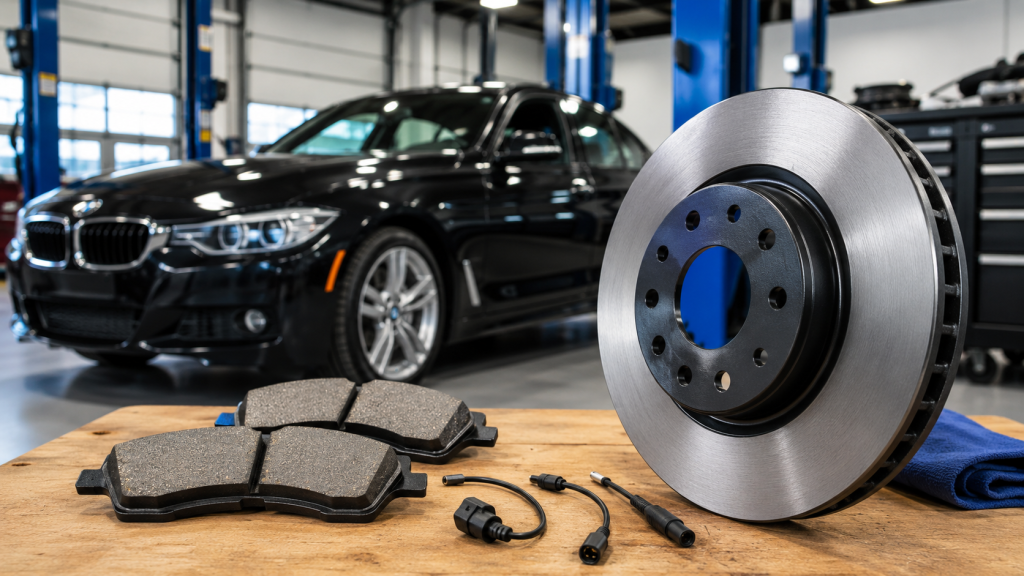
A BMW brake wear sensor is a physical electronic sensor mounted directly into the brake pad material. As the brake pad gradually wears down, the sensor moves closer to the rotor surface. Once the pad reaches a calibrated wear threshold, the rotor contacts the sensor and breaks the electrical circuit inside it. That interruption signals the BMW monitoring system to activate a brake service warning through the dashboard and iDrive service system.
This process explains why BMW brake warnings can sometimes appear suddenly. The sensor does not slowly dim or gradually activate over weeks. Once the circuit breaks, the system recognizes that the brake pad has crossed the designed wear threshold.
BMW uses this setup because brake pads do not always wear evenly across all driving situations. Urban traffic, repeated stop and go driving, downhill braking, and aggressive braking force generate very different heat and friction levels than steady highway travel. Electronic monitoring allows the system to track wear more precisely than mileage alone.
Important brake sensor characteristics include:
• Sensors physically contact the rotor at wear threshold
• Front and rear brake systems use separate monitoring logic
• Sensor activation triggers dashboard service notifications
• Most BMW sensors require replacement during brake service
• iDrive service calculations adjust based on wear progression
A brake warning does not automatically indicate immediate brake failure. In most situations, the warning indicates that the pad material has reached a planned service threshold designed to preserve braking stability and rotor condition before severe wear develops.
Why BMW Brake Service Timing Varies Between Vehicles
BMW brake service intervals vary because braking load changes dramatically based on vehicle weight, traffic exposure, driving speed, and braking frequency. A BMW X5 driven daily through dense urban traffic will place far more thermal stress on the brake system than a BMW 530i driven primarily on open highways.
Every braking event converts vehicle motion into heat through friction between the brake pads and rotors. Heavier vehicles generate larger braking loads because more mass must be slowed during deceleration. SUVs therefore place different stress levels on brake materials than lighter sedan platforms.
Driving style also changes brake wear timing substantially. Smooth braking distributes heat more gradually across the rotor surface. Aggressive braking creates sharper heat spikes that accelerate friction material breakdown and rotor surface wear.
Several variables shape BMW brake service timing:
• Vehicle curb weight
• Wheel and tire size
• Traffic density
• Driving speed distribution
• Brake force frequency
• Rotor heat cycling
• Pad compound composition
This explains why identical BMW models can still produce different brake service intervals. The electronic monitoring system tracks actual wear progression instead of relying entirely on fixed mileage estimates.
Why Rear Brakes Sometimes Wear Faster on BMW Models
Many drivers assume front brakes always wear faster because front axle braking handles most stopping force during deceleration. While the front brakes still manage the majority of braking load, modern BMW stability systems now distribute braking force more dynamically across all four wheels.
Electronic stability control, traction management, brake vectoring, and adaptive braking calculations can increase rear brake usage during cornering correction, slippery surface stabilization, and vehicle balance adjustments. This added rear axle engagement changes wear distribution patterns compared to older braking systems.
BMW sedans and SUVs also manage brake bias differently based on vehicle configuration. A BMW 5 Series maintains different weight transfer characteristics than a taller SUV platform like the BMW X3 or BMW X5. That difference changes how braking pressure distributes during deceleration.
Rear brake wear can accelerate due to:
• Electronic stability correction activity
• Urban traffic braking frequency
• Hill descent braking assistance
• Adaptive cruise braking inputs
• Weight transfer management
• Stop and go commuting exposure
This is why rear brake warnings appearing first on some BMW vehicles does not automatically indicate a malfunction. The wear pattern may simply reflect how the braking system distributes load across the vehicle during normal operation.
Rotor Wear and Heat Cycles Change Brake Replacement Timing
Brake pads are only one part of the BMW brake service equation. Rotors also absorb massive thermal stress during braking. Every stop creates friction heat that expands and contracts the rotor surface repeatedly over time. Those repeated heat cycles gradually wear down rotor thickness and can alter rotor surface smoothness.
Rotor condition directly impacts braking consistency because uneven rotor surfaces reduce how evenly the brake pads contact the rotor face. Scoring, heat spotting, and thickness variation can create vibration, noise, or unstable braking feel during deceleration.
BMW brake systems are engineered with specific pad and rotor material pairings. Once brake pads wear close to their service threshold, the rotor may already contain enough thermal wear to justify replacement during the same service visit.
Several factors accelerate rotor wear:
• Repeated high heat braking
• Heavy vehicle mass
• Aggressive deceleration
• Mountain driving exposure
• Uneven pad wear
• Delayed brake service timing
Rotor replacement recommendations are not simply upsell driven maintenance suggestions. In many situations, the rotor thickness or surface condition no longer supports proper braking stability with a fresh pad set installed against it.
What Owners Should Evaluate When a BMW Brake Warning Appears
A BMW brake warning should trigger an inspection decision, not immediate panic or complete dismissal. The warning exists to identify that the brake pad material has crossed a monitored wear threshold and that the braking system should be evaluated before rotor wear or braking consistency begins to decline further.
Drivers should first consider how the vehicle has been used leading up to the warning. Heavy traffic exposure, steep terrain, repeated short trip driving, and aggressive braking patterns all accelerate wear progression.
Owners evaluating BMW brake service timing should review:
• Brake pad thickness remaining
• Rotor surface condition
• Brake vibration during stopping
• Noise during braking
• Brake fluid service history
• Front versus rear wear distribution
• Driving pattern exposure
BMW brake wear sensors exist to provide earlier visibility into braking wear progression before braking quality deteriorates substantially. Understanding how those sensors function helps owners evaluate service timing more accurately and interpret brake warnings with greater clarity.
Connect with us


